


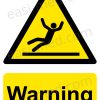


Warning Slip Hazard Sign – Critical Safety Communication
The Warning Slip Hazard Sign provides essential safety communication for any environment where slip risks present ongoing concerns. This professional slip hazard warning sign delivers clear, immediate notification to employees, visitors, and customers about areas where slipping hazards exist, helping to prevent accidents and injuries while ensuring your business meets its legal health and safety obligations. Whether you operate a commercial facility, industrial site, or public building, this warning slippery floor sign represents a fundamental component of comprehensive workplace safety management and regulatory compliance.
Understanding the Critical Nature of Slip Hazards
Slip hazards constitute the most common cause of workplace accidents across all sectors in the United Kingdom. According to Health and Safety Executive comprehensive data analysis, slips and trips consistently account for 35-40% of all major reported workplace injuries annually, translating to tens of thousands of serious accidents each year. The financial burden on UK businesses is staggering, with total costs estimated at over £500 million annually when accounting for direct costs including compensation payments, legal fees, and insurance premiums, plus indirect costs such as lost productivity, staff replacement, accident investigation, and reputational damage.
Beyond statistics and financial implications, the human cost of slip accidents demands serious consideration. Slip injuries range from relatively minor bruises, cuts, and sprains requiring basic first aid, through to more serious outcomes including fractures, dislocations, ligament damage, back and spinal injuries, head trauma with potential for concussion or brain injury, and in the most serious cases, permanent disabilities or fatalities. The psychological impact on victims can be substantial, with anxiety about movement, fear of falling, and reduced confidence affecting quality of life and ability to work. Witnesses to serious accidents may also experience trauma, affecting workplace morale and creating broader safety concerns.
Installing appropriate slip hazard warning signs fulfils multiple critical functions within effective health and safety management. These signs provide immediate visual alert to known hazards, enabling people to modify their behavior accordingly. They demonstrate legal compliance with UK health and safety regulations that require hazard communication. They show duty of care to employees, visitors, and the public by actively warning of known risks. They provide documented evidence of risk assessment and implementation of control measures. They help defend against liability claims by showing proactive hazard management. Most importantly, they help prevent accidents and protect people from unnecessary harm. Proper deployment of warning slip hazard signs isn’t merely regulatory box-ticking – it’s fundamental to protecting people and safeguarding your business from preventable accidents and their serious consequences.
When to Deploy Warning Slip Hazard Signs
This slip risk warning sign is specifically designed for permanent or long-term installation in locations where slip hazards represent ongoing concerns requiring constant awareness and caution. Understanding when to use these warning signs versus temporary signage helps ensure appropriate risk communication. Permanent warning slip hazard signs are appropriate for areas with inherently slippery flooring materials that cannot be easily changed, locations regularly exposed to moisture or contaminants that create ongoing slip risks, surfaces that become hazardous under certain predictable conditions, transition zones between different surface types or levels, inclined surfaces where gradients increase slip potential, outdoor areas exposed to weather conditions creating persistent hazards, and high-traffic locations where constant vigilance is required.
Common scenarios requiring permanent warning slippery floor signs include polished stone, marble, or tile floors with inherently low slip resistance particularly when wet, areas near entrances where weather brings rain, snow, or ice melt indoors regardless of cleaning efforts, locations adjacent to swimming pools, showers, or wet rooms where moisture is constantly present, industrial environments where process water, oils, or other substances regularly contact floors, food preparation areas where water and grease create persistent slip conditions despite regular cleaning, external walkways exposed to rain, algae growth, or winter ice, ramps and inclined surfaces where any moisture dramatically increases slip risk, and areas with smooth sealed concrete that becomes hazardous when contaminated with dust or moisture.
Key Features of Our Warning Slip Hazard Sign
- ISO 7010 compliant design – incorporates the internationally standardised yellow warning triangle with slip hazard pictogram, ensuring universal instant recognition across all languages, literacy levels, cultural backgrounds, and international audiences.
- High visibility construction – bold yellow background creates maximum contrast with black symbol and text, ensuring the sign catches attention immediately even in visually busy environments, challenging lighting conditions, or from significant distances.
- Clear warning message – simple “Warning” text combined with universally recognised slip pictogram communicates the hazard explicitly without relying on language comprehension or literacy.
- Professional appearance – clean, standardised design maintains workplace aesthetics and professional image while fulfilling essential safety communication functions effectively.
- Durable construction – manufactured from premium quality materials specifically selected and engineered to withstand years of continuous use in demanding workplace environments.
- Weather resistant materials – suitable for both indoor and outdoor applications with excellent resistance to moisture, temperature fluctuations, and environmental exposure.
- UV stable formulation – won’t fade, discolour, or deteriorate when exposed to sunlight, maintaining visibility and effectiveness throughout extended service life.
- Chemical resistant finish – maintains appearance and legibility even when exposed to common cleaning chemicals, industrial solvents, and workplace contaminants.
- Impact resistant construction – particularly in rigid PVC format, withstands accidental impacts without damage that would compromise appearance or effectiveness.
- Flexible mounting options – available in self-adhesive vinyl for quick, tool-free application or rigid PVC for mechanical fixing, offering solutions for any installation requirement or substrate.
- Multiple size options – A5, A4, and A3 formats enable optimal sizing based on viewing distance, location characteristics, visibility requirements, and environmental factors.
Available Sizes for Every Application
- A5 (148 × 210 mm) – the compact warning slip hazard sign ideal for smaller spaces including compact retail units, small office areas, domestic properties, tight corridors, individual equipment warnings, and confined spaces where larger signs would be impractical but clear hazard communication remains essential for safety.
- A4 (210 × 297 mm) – the versatile standard size suitable for most general applications including typical office buildings, retail shops, healthcare facilities, educational institutions, restaurants, and standard commercial environments where signs need visibility at normal pedestrian approach distances and speeds.
- A3 (297 × 420 mm) – the large format option designed for warehouses, industrial facilities, large retail units, car parks, loading bays, distribution centres, and expansive open areas where signs must be visible from considerable distances, in environments with substantial visual distractions, or where early warning is critical for safety.
Selecting the appropriate size requires careful consideration of multiple practical factors. Assess typical viewing distances – how far away will people be when they first encounter the hazard and need warning? Evaluate ambient lighting levels and determine whether natural light, artificial lighting, or both will illuminate the sign. Consider traffic patterns and approach speeds – faster-moving pedestrians or vehicle operators need earlier, more prominent warnings. Account for visual clutter including other signage, equipment, stock, or architectural features that might reduce sign visibility. Assess whether signs will be viewed head-on or at angles that might reduce legibility. When uncertain between two sizes, selecting the larger option provides better advance warning, reduces the risk someone might miss the notification, and demonstrates your commitment to maximum safety communication.
Material Options for Different Environments
Self-Adhesive Vinyl Warning Signs
Our self-adhesive vinyl slip hazard warning signs deliver convenient, cost-effective solutions particularly suited to indoor applications and some sheltered outdoor locations. The premium calendared vinyl material features a strong permanent acrylic adhesive backing specifically engineered to create reliable, long-lasting bonds to properly prepared smooth surfaces including painted walls, doors, glazed tiles, glass panels, metal surfaces, plastic laminates, sealed wood, and other common workplace substrates. The vinyl surface incorporates a matt finish that minimises glare and reflections, ensuring excellent visibility under varying lighting conditions including bright overhead lighting or direct sunlight that might cause glossy signs to reflect and become difficult to read.
Advanced digital printing technology utilising UV-resistant pigmented inks ensures excellent colour reproduction, sharp text definition, crisp symbol rendering, and long-term fade resistance that maintains sign effectiveness throughout its service life. The thin profile means vinyl signs sit virtually flush against mounting surfaces, creating a neat, professional appearance that integrates seamlessly with modern interior design while avoiding protruding edges that could catch on passing traffic, cleaning equipment, or trolleys, or create additional hazards. Installation requires no special tools, technical skills, or mechanical fixings – simply peel away the backing paper and apply – making vinyl signs ideal for rental properties, leased premises, temporary installations, listed buildings where drilling isn’t permitted, and any location where permanent alterations must be avoided.
Rigid PVC Plastic Warning Signs
For maximum durability, outdoor applications, or locations where signs may experience physical impacts or harsh environmental conditions, our rigid PVC plastic warning slip hazard signs represent the premium, long-lasting choice. These professional-grade signs are manufactured from 3mm thick rigid PVC sheet that delivers excellent impact resistance, dimensional stability, and extended service life measured in years rather than months. The robust construction prevents bending, warping, flexing, or damage from accidental impacts, maintaining pristine appearance and full effectiveness even in demanding industrial environments, high-traffic locations, or areas where signs might be subject to rough treatment.
Rigid PVC material excels in outdoor environments where signs face continuous exposure to challenging conditions including rain, snow, sleet, ice, temperature extremes from freezing winter conditions to hot summer sun, direct sunlight, and intense UV radiation. The material is completely waterproof and non-absorbent, preventing moisture ingress, swelling, delamination, warping, or structural degradation that affects some other materials when repeatedly wetted and dried. Built-in UV stabilisers prevent fading, colour shift, chalking, surface degradation, and embrittlement, ensuring the sign maintains vibrant appearance and perfect legibility throughout many years of continuous outdoor exposure without requiring replacement or maintenance.
Mounting versatility represents another significant advantage of rigid PVC signs, with multiple professional installation options including screw fixing through pre-drilled holes or self-drilled corners for secure permanent mounting, adhesive fixing using double-sided foam tape or construction adhesive for clean installation without visible fixings or surface damage, cable tie mounting through drilled holes for attachment to railings, mesh panels, chain link fencing, or posts, magnetic backing (available on request) for temporary placement on steel surfaces allowing repositioning as needed, or standoff mounting using spacers for dimensional signage that stands proud of the mounting surface. This exceptional versatility ensures appropriate, secure installation regardless of substrate type, surface condition, access constraints, or specific installation requirements.
Comprehensive Application Guide
This professional slip risk warning sign is essential across diverse commercial, industrial, institutional, and public sectors where slip hazards require clear communication:
- Retail environments – supermarkets, shops, shopping centres, department stores, convenience stores, and retail units where polished floors, regular cleaning, customer spillages, and weather-related moisture create ongoing slip hazards requiring permanent warning signage.
- Hospitality sector – hotels, restaurants, cafes, pubs, bars, clubs, nightclubs, and entertainment venues where smooth floors, food service operations, beverage spillages, and high customer traffic generate constant slip risks despite diligent cleaning and maintenance.
- Healthcare facilities – hospitals, clinics, medical centres, dental surgeries, care homes, nursing facilities, and rehabilitation centres where hygiene standards demand smooth, easily cleaned flooring that presents inherent slip risks, particularly for elderly or infirm patients.
- Educational institutions – schools, colleges, universities, nurseries, training centres, and educational facilities where active environments, high student traffic, youth energy, varied weather conditions, and diverse activities create regular slip hazards.
- Office buildings – corporate offices, business parks, commercial buildings, and professional premises where entrance lobbies, corridors, kitchens, washrooms, and common areas require regular cleaning and weather tracks moisture indoors.
- Leisure facilities – gyms, swimming pools, sports centres, fitness studios, changing rooms, shower facilities, spas, and recreation venues where water is inherently present and wet, slippery floors represent constant safety concerns.
- Industrial sites – factories, workshops, warehouses, distribution centres, manufacturing plants, and production facilities where process water, oils, chemicals, dust, or material handling create slippery conditions on smooth concrete or coated floors.
- Food processing and preparation – commercial kitchens, food production facilities, bakeries, butchers, fishmongers, and catering operations where water, grease, food waste, and hygiene
cleaning create constant wet floor challenges. - Transport facilities – airports, train stations, bus terminals, ferry ports, coach stations, and car parks where weather exposure, high passenger volumes, and tracked-in moisture bring water and contaminants indoors constantly.
- Public buildings – libraries, museums, galleries, civic centres, town halls, court buildings, and government facilities where public access requirements and professional standards demand clear safety communication.
- Residential properties – apartment buildings, retirement complexes, student accommodation, housing associations, and private homes where communal areas, bathrooms, kitchens, and entrance areas present slip risks to residents and visitors.
- External areas – outdoor walkways, ramps, bridges, platforms, access routes, car parks, and pathways with smooth surfaces exposed to rain, ice, snow, moss, algae growth, or cleaning operations creating wet, slippery conditions.
Legal Compliance and Regulatory Framework
Displaying appropriate warning slip hazard signs helps ensure full compliance with extensive UK health and safety legislation that places explicit duties on employers and duty holders. The Health and Safety at Work Act 1974 establishes the fundamental legal framework, placing general duties on employers to ensure, so far as reasonably practicable, the health, safety, and welfare at work of all employees and to protect others who may be affected by work activities. This general duty extends explicitly to providing and maintaining safe premises, plant, and systems of work, which necessarily includes identifying, assessing, and addressing slip hazards through appropriate control measures including effective warning signage when elimination or reduction methods cannot fully control risks.
The Workplace (Health, Safety and Welfare) Regulations 1992 contain specific detailed provisions regarding floors and traffic routes in workplaces. Regulation 12 requires that every floor in a workplace and the surface of every traffic route shall be suitable for the purpose for which it is used, be in good condition, and be free from obstructions and from any article or substance which may cause persons to slip, trip, or fall. The Approved Code of Practice accompanying these regulations explicitly states that where slip hazards cannot be eliminated or adequately controlled by other means, employers must implement appropriate alternative control measures, specifically mentioning warning signs as suitable controls. The regulations also require regular inspection and maintenance of floors, with any defects causing slip risks requiring prompt remedial action including warning signage if immediate repair isn’t possible.
The Health and Safety (Safety Signs and Signals) Regulations 1996 implement European directives on safety signage within UK workplaces. These regulations require employers to provide and maintain appropriate safety signs where risks to the health and safety of employees cannot be avoided or adequately controlled by other means, such as engineering controls or safe systems of work. The regulations specify that signs must conform to recognised standards, and our ISO 7010 compliant slip hazard warning signs meet these requirements completely, ensuring legal compliance and best practice. The regulations also place duties on employers to ensure employees understand the meaning of safety signs and know what action to take when they see them, making standardised internationally recognised symbols particularly valuable as they transcend language barriers, literacy differences, and cultural variations to ensure universal understanding.
The Management of Health and Safety at Work Regulations 1999 require all employers to conduct suitable and sufficient risk assessments of workplace activities, identifying hazards and evaluating risks to employees and others who may be affected. Following risk assessment, employers must implement appropriate preventive and protective measures based on established principles of prevention. Installing warning slippery floor signs demonstrates you’ve systematically assessed slip risks and implemented reasonable, appropriate controls as part of comprehensive risk management. This documentation and physical evidence of risk control implementation proves invaluable if accidents occur or enforcement authorities conduct inspections, as it clearly shows you identified hazards, understood associated risks, took proactive preventive action, and provided clear warnings rather than waiting for incidents to happen before addressing problems. Such evidence significantly strengthens legal positions and demonstrates conscientious discharge of legal duties.
Professional Installation Instructions
Installing Self-Adhesive Vinyl Signs: Successful vinyl sign installation depends critically on proper surface preparation and careful, methodical application technique. Begin by selecting the optimal mounting location where the sign will be clearly visible to people approaching the hazard area from all likely directions and distances, ensuring no obstructions block sightlines. The mounting surface must be smooth, perfectly clean, completely dry, and free from any texture, dust, dirt, grease, oil, moisture, wax, or contamination that might compromise adhesive bonding.
Clean the surface thoroughly and systematically using an appropriate degreasing agent or multi-purpose cleaner to remove all contamination, grease, and residues. Wipe down with clean water to remove cleaning product residues, then dry completely using a clean, lint-free cloth. Allow adequate drying time in the ambient environment – any residual moisture beneath the vinyl will prevent proper adhesive bonding and cause eventual failure through edge lifting or complete detachment. Conduct a final inspection to ensure the surface is perfectly prepared before proceeding with application.
Once the surface meets requirements, position the sign at the desired location and mark lightly with pencil if needed to ensure correct placement, alignment, and height. Peel back approximately 50mm of the backing paper liner and carefully align the exposed adhesive edge with your positioning marks. Press the exposed adhesive section firmly onto the surface using hand pressure, carefully checking alignment is absolutely correct before proceeding further as repositioning after significant contact may compromise final adhesion. Gradually peel away more backing paper while simultaneously pressing the sign down firmly with your hand or a plastic squeegee, working methodically and steadily from the centre outwards towards the edges to eliminate air bubbles and ensure complete contact. Use firm, even pressure with smooth, overlapping strokes. If small air bubbles remain after installation, they can usually be carefully punctured with a clean pin and smoothed completely flat.
For optimal adhesion results, avoid installation in very cold conditions (below 10°C) as adhesive performance is significantly reduced at low temperatures and may not achieve full bonding strength. Ideal application temperature range is 15-25°C in low humidity conditions. After installation, allow 24-48 hours for the adhesive to cure fully and achieve maximum bond strength before subjecting the sign to cleaning, moisture exposure, temperature extremes, or harsh conditions. Avoid using excessive force, pulling, or stretching the vinyl material during application, as this can cause material distortion, dimensional changes, or edge lifting over time that compromises both appearance and long-term durability.
Installing Rigid PVC Signs: Rigid signs offer multiple professional mounting options depending on substrate type, structural requirements, and installation permanence needs. For screw mounting, position the sign precisely at the desired location and mark drilling positions through existing mounting holes or at appropriate positions near corners that ensure secure mounting without compromising sign structural integrity. If the sign doesn’t have pre-drilled mounting holes, carefully drill 4-6mm diameter holes at suitable positions. Remove the sign and drill mounting holes in the substrate using drill bits appropriate for the specific material – masonry bits for brick, concrete, or stone, standard twist bits for wood, and metal bits for steel or aluminum. For masonry substrates, insert appropriate wall plugs sized to match both the drilled hole and fixing screws. Reposition the sign carefully and secure with suitable screws – typically 4-5mm diameter self-tapping screws for wood or metal substrates, or machine screws for masonry installations with wall plugs. Tighten screws firmly to ensure secure mounting but avoid overtightening which may crack the PVC material or cause localized stress concentrations.
For adhesive mounting, thoroughly clean the substrate following procedures described above and allow to dry completely. Apply high-quality double-sided foam tape (minimum 1mm thick for good surface conformity and gap-filling capability) or construction adhesive specifically formulated for bonding PVC to your substrate material. Follow adhesive manufacturer’s instructions regarding coverage, open time, and curing requirements. Position the sign carefully as repositioning after initial contact may compromise final adhesion strength. Press firmly and evenly across the entire sign surface for at least 30-60 seconds to ensure good initial contact and squeeze-out. For critical applications, heavy signs, or outdoor exposed locations, consider using both adhesive and mechanical fixings in combination for maximum security and redundancy. Cable tie mounting suits railings, mesh panels, chain link fencing, and similar open structures – drill small holes at sign corners if not pre-drilled using appropriate drill bit size for your cable tie width, then secure with UV-resistant cable ties specifically rated for outdoor use to prevent premature ultraviolet degradation and failure.
Comprehensive Slip Prevention Strategy
While this warning slip hazard sign represents an essential component of workplace safety management, it should form one element within a comprehensive, multi-layered slip prevention programme rather than existing as an isolated standalone measure. The established hierarchy of risk control in occupational health and safety management prioritises elimination and reduction of hazards above warning systems and personal protective equipment. Before relying solely on warning signage, systematically consider whether slip risks can be eliminated or significantly reduced through preferred control methods.
Higher-level controls to consider include selecting flooring materials with appropriate slip resistance ratings for the intended use and likely contamination, applying anti-slip treatments or coatings to existing floors to improve slip resistance performance, installing effective drainage systems to remove water and liquid contaminants more rapidly, implementing improved cleaning procedures that minimize water use, reduce drying times, or avoid creating temporary slip hazards, installing environmental controls such as entrance matting systems to capture moisture before it spreads throughout premises, implementing design changes that eliminate activities or processes creating wet conditions, improving lighting to increase hazard visibility and allow earlier response, and providing appropriate footwear with suitable slip resistance for staff working in high-risk areas.
However, where hazards cannot be eliminated or adequately controlled through these preferred engineering and procedural methods, appropriate warning signage becomes essential as a supplementary control. Best practice involves integrating your slip risk warning signs with complementary measures including regular scheduled inspections to promptly identify emerging hazards, effective cleaning procedures that balance hygiene requirements with slip risk minimization, clearly defined protocols for sign deployment, staff training and competency assessment, good housekeeping practices, adequate lighting throughout facilities, robust incident reporting and investigation systems, and periodic management review of control measures effectiveness with continuous improvement initiatives.
Order Your Warning Slip Hazard Signs Today
Don’t wait for a slip accident to demonstrate the critical importance of proper safety signage. Order professional Warning Slip Hazard Signs from Easi-Signs today and take decisive, proactive steps to protect people while ensuring full legal compliance with comprehensive UK health and safety regulations. Available in A5, A4, and A3 sizes with your choice of convenient self-adhesive vinyl or durable rigid PVC plastic materials to suit any application, environment, budget, and installation requirement. All our slip hazard warning signs are manufactured in the United Kingdom to exacting quality standards, ensuring excellent print clarity and colour accuracy, extended service life, and complete compliance with ISO 7010 international standards and UK regulatory requirements.
We offer highly competitive pricing with substantial volume discounts available for bulk orders, making it cost-effective to properly equip all areas requiring slip hazard signage across single sites or multiple locations nationally. Fast order processing and dispatch mean your signs are sent quickly, and reliable UK-wide delivery ensures they reach you when needed. Our experienced, knowledgeable customer service team provides expert guidance on sign selection, sizing, material choice, optimal placement strategies, and any other aspects of your safety signage requirements. We’re here to help you make informed decisions for your specific circumstances and ensure your safety signage programme achieves maximum effectiveness and compliance. Order today and benefit from professional quality products, competitive prices, expert support, and confidence.
Related Safety Signs
Browse our extensive range of Warning Signs to address all workplace hazards comprehensively. Related products include Caution Wet Floor, Caution Slippery Floor, Warning Slippery Surface, Caution Slippery Floor Spillage, Wet Floor, Caution Trip Hazard, and Mind Your Step signs. Easi-Signs is your trusted UK supplier for professional safety signage.
Reviews
There are no reviews yet.